
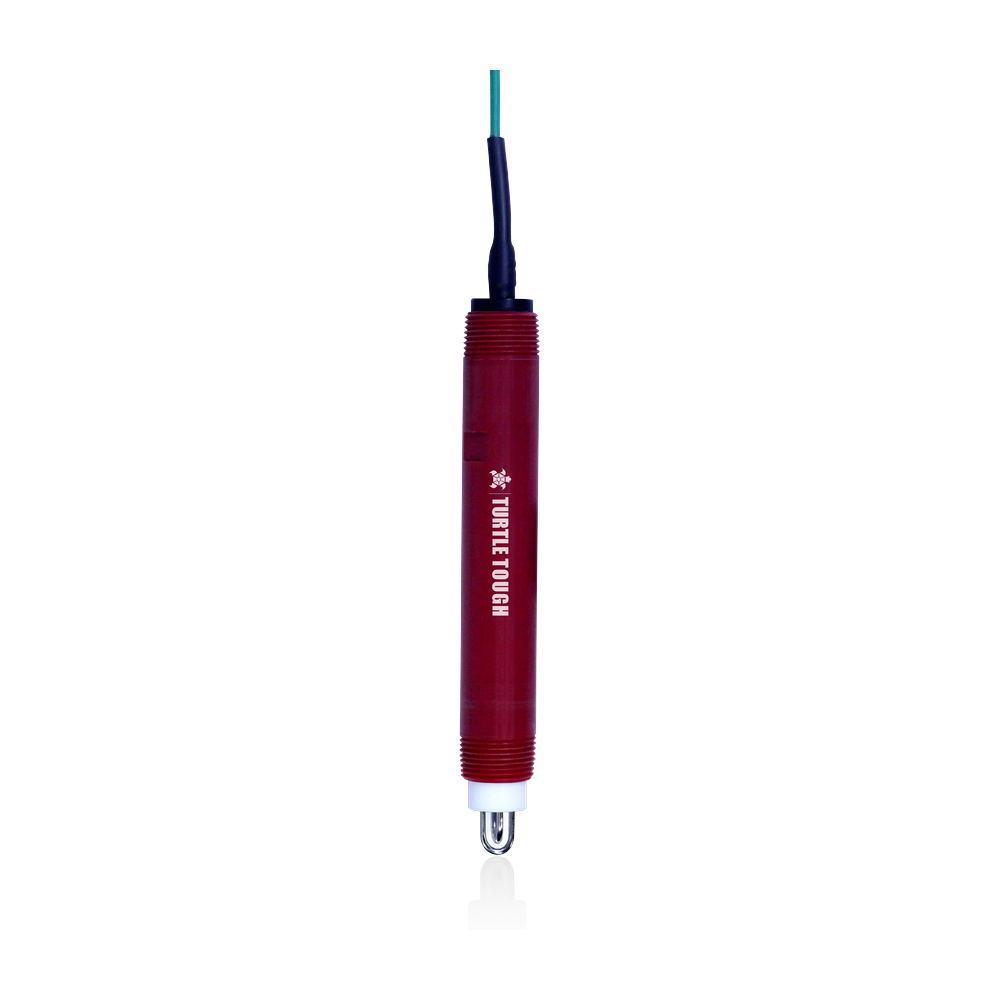
ULTRA Series Digital Smart Conductivity Sensor
The ULTRA Series Digital Smart Conductivity Sensor from Turtle Tough has integral RS-485 Modbus RTU communications for a simple, fully portable installation. The sensor can be calibrated anywhere – in the lab, shop or field – and connected directly to any data acquisition or control system.
Temperature and cell constant calibrations can also be done with the sensor left in service if grab-sample adjustments are needed. Waterproof, corrosion-resistant NEMA 6P quick-connect plugs come standard for easy hot-swapping during cleaning, recalibration and maintenance.
FAQ
What is a conductivity sensor?
A conductivity sensor measures how well a liquid conducts electricity, which rises with the concentration of dissolved ions. It is widely used to monitor water purity, total dissolved solids (TDS), salinity, chemical concentration and cooling tower or boiler water quality.
How does a contacting conductivity sensor work?
A contacting sensor applies an alternating voltage across electrodes in contact with the liquid and measures the resulting current. The electrode geometry is described by the cell constant (K): lower cell constants suit low-conductivity water, and higher cell constants suit more conductive solutions. Temperature compensation corrects the reading to a reference temperature, typically 25 °C.
What are the advantages of the ULTRA Series conductivity sensor?
- Stores temperature and cell constant calibrations, including days in use since each calibration
- Redundant O-ring seals for high on-stream reliability and long service life
- Open front-end geometry resists clogging and reduces maintenance – ideal for remote sites
- Standard and High ranges are user-selectable on the same hardware
- Computed salinity (PSU) and selectable TDS units (NaCl, KCl or 442)
- Connects directly to PLC/SCADA/DCS – no analyser required
Specifications
- Measurement range: 20 to 200,000 µS/cm (Ultralow Range option extends down to 0.2 µS/cm)
- Cell constants: K = 0.1, 0.2, 1.0 or 2.0 /cm
- Output: DSS1 – Modbus RTU (RS-485)
- Operating temperature: −35 to +120 °C (−31 to +248 °F) inline; −15 to +85 °C (+5 to +185 °F) submersible
- Operating pressure: max 100 psig at 120 °C
- Process connection: 1″ MNPT Kynar front and rear threads
- Wetted materials: Kynar body, Teflon insulator, EPDM O-rings, 316SS electrodes
- Temperature element: Pt1000, −40 to +210 °C (−40 to +410 °F) input range, ±0.3 °C
- Cable: 6 m (20 ft) standard, 12 m (40 ft) optional; runs up to 1,000 m with a 12 VDC supply
- End of cable: NEMA 6P quick-connect plug
What installation types are available?
Sanitary inline sensor holder, ULTRA Series inline hot-tap assembly, TOUGH Series insertion rod, and immersion applications, including fully submersible installation on an immersion rod.
What customization options are available?
High temperature and pressure (HTP) version, fully submersible Kynar body (SUB), Ultra Low Range hardware (must be specified at order), PEEK insulator, Viton, AFLAS or KALREZ O-rings, titanium, Monel or Hastelloy C-276 electrodes, 12 m cable, and vinyl or norprene cable protection.